
Best Picture Winner
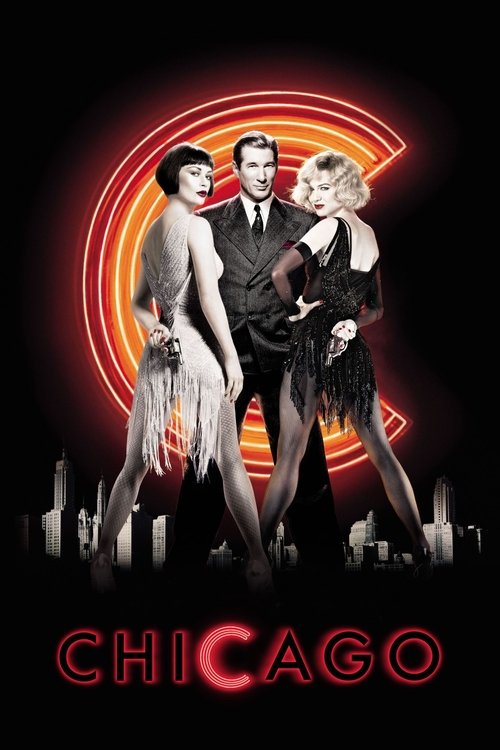
Chicago
Best Picture
Director: Rob Marshall
Studio: Miramax
Two murderesses in 1920s Chicago compete for fame, fortune, and media attention as they await trial.
All Categories (28)
Animated Feature Film
Spirited Away— Hayao Miyazaki
Winner
Ice Age— Chris Wedge
Lilo & Stitch— Chris Sanders
Spirit: Stallion of the Cimarron— Jeffrey Katzenberg
Treasure Planet— Ron Clements
Best Picture
Chicago— Martin Richards, Producer
Winner
Gangs of New York— Alberto Grimaldi and Harvey Weinstein, Producers
The Hours— Scott Rudin and Robert Fox, Producers
The Lord of the Rings: The Two Towers— Barrie M. Osborne, Fran Walsh and Peter Jackson, Producers
The Pianist— Roman Polanski, Robert Benmussa and Alain Sarde, Producers
Actor In A Leading Role
Daniel Day-Lewis— Gangs of New York {"Bill 'The Butcher' Cutting"}
Jack Nicholson— About Schmidt {"Warren Schmidt"}
Michael Caine— The Quiet American {"Thomas Fowler"}
Nicolas Cage— Adaptation {"Charlie Kaufman & Donald Kaufman"}
Actor In A Supporting Role
Christopher Walken— Catch Me If You Can {"Frank Abagnale"}
Ed Harris— The Hours {"Richard Brown"}
John C. Reilly— Chicago {"Amos Hart"}
Paul Newman— Road to Perdition {"John Rooney"}
Actress In A Leading Role
Diane Lane— Unfaithful {"Connie Sumner"}
Julianne Moore— Far from Heaven {"Cathy Whitaker"}
Renée Zellweger— Chicago {"Roxie Hart"}
Salma Hayek— Frida {"Frida Kahlo"}
Actress In A Supporting Role
Julianne Moore— The Hours {"Laura Brown"}
Kathy Bates— About Schmidt {"Roberta Hertzel"}
Meryl Streep— Adaptation {"Susan Orlean"}
Queen Latifah— Chicago {"Matron Mama Morton"}
Directing
Chicago— Rob Marshall
Gangs of New York— Martin Scorsese
Talk to Her— Pedro Almodóvar
The Hours— Stephen Daldry
Writing (Adapted Screenplay)
The Pianist— Screenplay by Ronald Harwood
Winner
About a Boy— Screenplay by Peter Hedges and Chris Weitz & Paul Weitz
Adaptation— Screenplay by Charlie Kaufman and Donald Kaufman
Chicago— Screenplay by Bill Condon
The Hours— Screenplay by David Hare
Writing (Original Screenplay)
Talk to Her— Written by Pedro Almodóvar
Winner
Far from Heaven— Written by Todd Haynes
Gangs of New York— Screenplay by Jay Cocks and Steve Zaillian and Kenneth Lonergan; Story by Jay Cocks
My Big Fat Greek Wedding— Written by Nia Vardalos
Y Tu Mamá También— Written by Carlos Cuarón and Alfonso Cuarón
Cinematography
Road to Perdition— Conrad L. Hall
Winner
Chicago— Dion Beebe
Far from Heaven— Edward Lachman
Gangs of New York— Michael Ballhaus
The Pianist— Pawel Edelman
Music (Original Score)
Frida— Elliot Goldenthal
Winner
Catch Me If You Can— John Williams
Far from Heaven— Elmer Bernstein
Road to Perdition— Thomas Newman
The Hours— Philip Glass
Music (Original Song)
"Lose Yourself" from 8 Mile— Music by Eminem, Jeff Bass and Luis Resto; Lyric by Eminem
Winner
"Burn It Blue" from Frida— Music by Elliot Goldenthal; Lyric by Julie Taymor
"Father And Daughter" from The Wild Thornberrys Movie— Music and Lyric by Paul Simon
"I Move On" from Chicago— Music by John Kander; Lyric by Fred Ebb
"The Hands That Built America" from Gangs of New York— Music and Lyric by Bono, The Edge, Adam Clayton and Larry Mullen
Art Direction
Chicago— Art Direction: John Myhre; Set Decoration: Gordon Sim
Winner
Frida— Art Direction: Felipe Fernandez del Paso; Set Decoration: Hania Robledo
Gangs of New York— Art Direction: Dante Ferretti; Set Decoration: Francesca Lo Schiavo
Road to Perdition— Art Direction: Dennis Gassner; Set Decoration: Nancy Haigh
The Lord of the Rings: The Two Towers— Art Direction: Grant Major; Set Decoration: Dan Hennah and Alan Lee
Visual Effects
The Lord of the Rings: The Two Towers— Jim Rygiel, Joe Letteri, Randall William Cook, Alex Funke
Winner
Spider-Man— John Dykstra, Scott Stokdyk, Anthony LaMolinara, John Frazier
Star Wars Episode II Attack of the Clones— Rob Coleman, Pablo Helman, John Knoll, Ben Snow
Film Editing
Chicago— Martin Walsh
Winner
Gangs of New York— Thelma Schoonmaker
The Hours— Peter Boyle
The Lord of the Rings: The Two Towers— Michael Horton
The Pianist— Hervé de Luze
Sound
Chicago— Michael Minkler, Dominick Tavella, David Lee
Winner
Gangs of New York— Tom Fleischman, Eugene Gearty, Ivan Sharrock
Road to Perdition— Scott Millan, Bob Beemer, John Patrick Pritchett
Spider-Man— Kevin O'Connell, Greg P. Russell, Ed Novick
The Lord of the Rings: The Two Towers— Christopher Boyes, Michael Semanick, Michael Hedges, Hammond Peek
Sound Editing
The Lord of the Rings: The Two Towers— Ethan Van der Ryn, Michael Hopkins
Winner
Minority Report— Richard Hymns, Gary Rydstrom
Road to Perdition— Scott A. Hecker
Costume Design
Chicago— Colleen Atwood
Winner
Frida— Julie Weiss
Gangs of New York— Sandy Powell
The Hours— Ann Roth
The Pianist— Anna Sheppard
Makeup
Frida— John Jackson, Beatrice De Alba
Winner
The Time Machine— John M. Elliott, Jr., Barbara Lorenz
Documentary (Feature)
Bowling for Columbine— Michael Moore, Michael Donovan
Winner
Daughter from Danang— Gail Dolgin, Vicente Franco
Prisoner of Paradise— Malcolm Clarke, Stuart Sender
Spellbound— Jeffrey Blitz, Sean Welch
Winged Migration— Jacques Perrin
Documentary (Short Subject)
Twin Towers— Bill Guttentag, Robert David Port
Winner
Mighty Times: The Legacy of Rosa Parks— Robert Hudson, Bobby Houston
The Collector of Bedford Street— Alice Elliott
Why Can't We Be a Family Again?— Roger Weisberg, Murray Nossel
Short Film (Animated)
The ChubbChubbs!— Eric Armstrong
Winner
Das Rad— Chris Stenner, Heidi Wittlinger
Mike's New Car— Pete Docter, Roger Gould
Mt. Head— Koji Yamamura
The Cathedral— Tomek Baginski
Short Film (Live Action)
This Charming Man (Der Er En Yndig Mand)— Martin Strange-Hansen, Mie Andreasen
Winner
Fait D'Hiver— Dirk Beliën, Anja Daelemans
I'll Wait for the Next One... (J'Attendrai Le Suivant...)— Philippe Orreindy, Thomas Gaudin
Inja (Dog)— Steven Pasvolsky, Joe Weatherstone
Johnny Flynton— Lexi Alexander, Alexander Buono
Foreign Language Film
Nowhere in Africa— Germany
Winner
El Crimen del Padre Amaro— Mexico
Hero— People's Republic of China
The Man without a Past— Finland
Zus & Zo— The Netherlands
Honorary Award
To Peter O'Toole, whose remarkable talents have provided cinema history with some of its most memorable characters.
Winner
Scientific And Technical Award (Academy Award Of Merit)
To ALIAS/WAVEFRONT for the development of a 3D animation, dynamics, modeling and rendering production tool known as Maya. With its significant and dominant impact on the motion picture industry, the Maya software package offers a robust and widely used commercial visual effects tool with a rich infrastructure for extension and customization. [Digital Imaging Technology]
Winner
To ARNOLD & RICHTER CINE TECHNIK and PANAVISION INC., for their continuing development and innovation in the design and manufacturing of advanced camera systems specifically designed for the motion picture entertainment industry. With a commitment that lies beyond the usual commercial considerations, these two manufacturers continue to lead the industry in developing and introducing products that have defined the state of the art in motion picture camera technology. [Camera]
Scientific And Technical Award (Scientific And Engineering Award)
To GLENN SANDERS and HOWARD STARK of Zaxcom for the concept, design and engineering of the portable Deva Digital Audio Disk Recorder. This innovative design employs advanced hard disk recording technology and digital audio techniques for use in both production and post-production recording applications. [Sound]
Winner
To DEDO WEIGERT for the concept, DR. DEPU JIN for the optical calculations, and FRANZ PETTERS for the mechanical construction of the Dedolight 400D. This uniquely designed set light provides superior performance, reliability and ease of use. Combined with its excellent array of accessories, the Dedolight 400D is an outstanding engineering achievement. [Lighting]
To DR. LESLIE GUTIERREZ, DIANE E. KESTNER, JAMES MERRILL and DAVID NIKLEWICZ for the design and development of the Kodak Vision Premier Color Print Film, 2393. This film stock provides filmmakers with enhanced color saturation, higher contrast and darker blacks, producing a bold, colorful 'look' on the theater screen. [Film]
To MARK ELENDT, PAUL H. BRESLIN, GREG HERMANOVIC and KIM DAVIDSON for their continued development of the procedural modeling and animation components of their Prisms program, as exemplified in the Houdini software package. Through a procedural building-block process, the Houdini software is used to simulate natural phenomena using particle effects and complex three-dimensional models. [Digital Imaging Technology]
Scientific And Technical Award (Technical Achievement Award)
To DICK WALSH for the development of the PDI/DreamWorks Facial Animation System. This effective software simulation system is used to create and control natural, expressive, highly-nuanced facial animation on a wide range of computer-generated characters. [Digital Imaging Technology]
Winner
JOHN A. BONNER MEDAL OF COMMENDATION
To Curt R. Behlmer in appreciation for outstanding service and dedication in upholding the high standards of the Academy of Motion Picture Arts and Sciences.
To ERIC DANIELS, GEORGE KATANICS, TASSO LAPPAS and CHRIS SPRINGFIELD for the development of the Deep Canvas rendering software. The Deep Canvas software program captures the orginal brush strokes of the traditional background artist to render elements in three dimensions for animated films. [Digital Imaging Technology]
To JIM SONGER for his contributions to the technical development of video-assist in the motion picture industry. The work of Jim Songer from 1968 through 1973 led directly to the more widespread acceptance of video-assist in the motion picture industry. [Systems]
To PIERRE CHABERT of Airstar for the introduction of balloons with internal light sources to provide set lighting for the motion picture industry. These helium-filled balloons with internal arrangements for tungsten halogen and HMI light sources, are usable indoors or out, quick to set up, require essentially no rigging and provide a soft light that can cover a very large area. [Lighting]
To RAWDON HAYNE and ROBERT W. JEFFS of Leelium Tubelites for their contributions to the development of internally lit balloons for motion picture lighting. These helium-filled balloons with internal arrangements for tungsten halogen and HMI light sources, are usable indoors or out, quick to set up, require essentially no rigging and provide a soft light that can cover a very large area. [Lighting]
To Richard B. Glickman in appreciation for outstanding service and dedication in upholding the high standards of the Academy of Motion Picture Arts and Sciences.
To THOMAS DRIEMEYER and to the TEAM OF MATHEMATICIANS, PHYSICISTS AND SOFTWARE ENGINEERS OF MENTAL IMAGES for their contributions to the Mental Ray rendering software for motion pictures. Mental Ray is a highly programmable computer-graphics renderer incorporating ray tracing and global illumination to realistically simulate the behavior of light in computer-generated imagery. [Digital Imaging Technology]