
Best Picture Winner
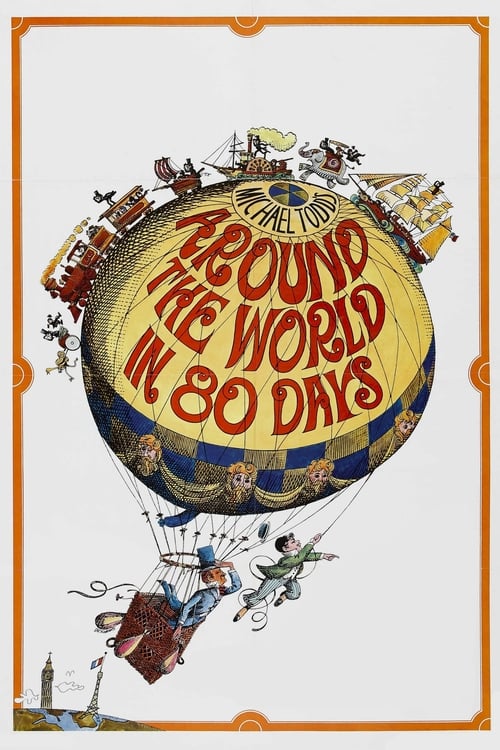
Around the World in 80 Days
Director: Michael Anderson
Studio: United Artists
A Victorian Englishman bets that he can circumnavigate the globe in eighty days with his resourceful valet.
From the Worthy Podcast
A Trip To The Moon
Broadcast journalist Edward R. Murrow presents an onscreen prologue, featuring footage from A Trip to the Moon (1902) by Georges Méliès, explaining that it is based loosely on the book From the Earth to the Moon by Jules Verne.
1902 French adventure short film directed by Georges Méliès. Inspired by a wide variety of sources, including Jules Verne's 1865 novel From the Earth to the Moon and its 1870 sequel Around the Moon, the film follows a group of astronomers who travel to the Moon in a cannon-propelled capsule, explore the Moon's surface, escape from an underground group of Selenites (lunar inhabitants), and return to Earth with a captive Selenite. Its ensemble cast of French theatrical performers is led by Méliès himself as main character Professor Barbenfouillis.
The pseudo-tracking shot in which the camera appears to approach the Man in the Moon was accomplished using an effect Méliès had invented the previous year for the film The Man with the Rubber Head. Rather than attempting to move his weighty camera toward an actor, he set a pulley-operated chair upon a rail-fitted ramp, placed the actor on the chair, and pulled him toward the camera. In addition to its technical practicality, this technique also allowed Méliès to control the placement of the face within the frame to a much greater degree of specificity than moving his camera allowed. A substitution splice allowed a model capsule to suddenly appear in the eye of the actor playing the Moon, completing the shot.
Similarly, film scholars have noted that the most famous moment in A Trip to the Moon plays with temporal continuity by showing an event twice: first the capsule is shown suddenly appearing in the eye of an anthropomorphic moon; then, in a much closer shot, the landing occurs very differently, and much more realistically, with the capsule actually plummeting into believable lunar terrain. This kind of nonlinear storytelling—in which time and space are treated as repeatable and flexible rather than linear and causal—is highly unconventional.
The Travel Film: first glob trotting film about world wide adventures and less about a personal story