
Best Picture Winner
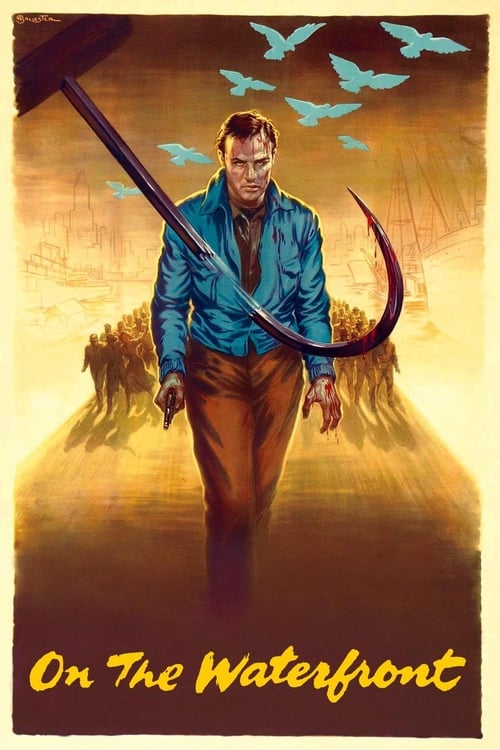
On the Waterfront
Director: Elia Kazan
Studio: Columbia
An ex-prizefighter turned longshoreman struggles to stand up to his corrupt union bosses.
From the Worthy Podcast
Aspect Ratio
Lock on to something, and focus on it. Let your eyes narrow in and frame it visually in your head. That object or thing you’re locking on became a cinematic moment. Creatively you framed something you saw to tell a story. The way films are told is through visual framing and tapping into a creative look that fits the narrative of what you want to tell. Think of your favorite action movie, every edit and camera angle is specifically chosen to convey the tension or rapidness the filmmakers wanted to put into the story of that car chase or gun fight.
Now, think outside the frame, literally. Those black bars that come up sometimes that you see on the top, bottom or sides of your screen, are most likely put there on purpose. It used to be common to see a box style frame, or 1.33:1 or 4:3. Filmmakers worked creatively in early Hollywood to create within that square frame and were met with great success. What changed was widening that frame. Pushing the boundaries of the literal film to push tone and emotions to a larger than life format. Just like how you naturally locked on to an object, filmmakers tried to capture that feeling on screen. That intense focus became desired. The widescreen format made film more natural and real. The wider the frame, the bigger the story felt. The drama was all the way to the sides of the canvas and felt like it can go on and on and on…
The 2013 Criterion Collection release presents the film in three aspect ratios: 1.66:1, 1.85:1, and 1.33:1. The accompanying booklet explains the reasoning behind this choice: "In 1953, Columbia Pictures was transitioning to the new widescreen format and declared that all its upcoming films, including On The Waterfront, would be suitable for projection in any aspect ratio from the full frame of 1.33:1 to the then widest standard of 1.85:1. The customary frame of European cinematographer Boris Kaufman (Twelve Angry Men, Baby Doll) split the difference at 1.66:1, so that all that was required was for him to leave extra room at the top and bottom of the frame and make sure that nothing essential would be lost in the widescreen presentation. At its premiere in 1954, On The Waterfront was projected at 1.85:1. Over subsequent decades, millions of television viewers became accustomed to seeing the film with the open-matte 1.33:1 framing, a presentation that has carried over into the home video era. Here, for the first time, Criterion is presenting the film in all three aspect ratios so that viewers can compare and choose the version they prefer."
This is the first film in 1.85:1 aspect ratio to win an Oscar for Best Picture.
On AFI’s catalog of On The Waterfront, it lists it with an aspect ratio of 1.85:1